
In his latest book, The Heir, author Matthew Palumbo provides a well-researched exposé of the left-wing globalist network developed by billionaire George Soros and the recent hand-off to his son, Alex. Palumbo chronicles Alex Soros’ assumption of his father’s political activism empire and his continuation of his father’s activist path, perhaps even more radical and brazenly public.
Born in 1985, Alex grew up in a 14-room estate in an upscale New York City suburb. He attended an elite private school where tuition for the 2024–25 school year exceeds $50,000.Alex succeeded his father as chair of George’s primary philanthropic organization, the Open Society Foundations (OSF), in December 2022. George, one of the most successful hedge fund managers in history, founded OSF in 1993 to support his philanthropic and political causes.
Alex had started his own foundation in 2012, the Alex Soros Foundation (ASF), that would be a strong indicator of how he would run OSF. From 2012 to 2021, ASF gave most of its $8.8 million in donations to environmental groups and almost half to hardcore leftist groups.
After assuming control of OSF, Alex reallocated much of the group’s resources away from Europe and toward the “global south.” Alex continued, however, George’s longstanding involvement in Ukraine and Albania in an effort to change those countries’ judicial systems to benefit left-wing political positions. The younger Soros also aggressively pushed support for environmental activist groups, announcing a $400 million commitment to support “economic and climate prosperity” in the global south.
Palumbo references a study by the Media Research Group that OSF donated the enormous amount of $193.9 million to 347 radical climate change activist groups from 2016 to 2023 under both George and Alex. But with the additional $425 million in donations referenced above, that amount increased to a whopping $618.9 million.
Aside from his massive monetary support for climate activism, Alex has also become a major donor to left-wing political groups and Democratic Party candidates at the highest levels. He donated tens of millions of dollars to Democratic candidates in 2020, including $720,000 to the Joe Biden presidential campaign. Alex’s donations enabled him to gain dozens of visits to the White House throughout the Biden presidency.
Palumbo writes that after the 2020 election, the incoming Biden administration engaged 17 members of OSF and other Soros-funded organizations to serve on the new administration’s transition teams. This enabled OSF to propagate its left-wing ideology across the State Department, the US Mission to the United Nations, the Defense Department, the National Security Council, the Treasury Department, the Labor Department, the Interior Department, the Federal Reserve, the Consumer Financial Protection Bureau, banking and securities regulators, and others. Some of these transition team members stayed on for positions in the Biden administration.
President Biden’s first chief of staff, Ron Klain, served on the board of the prominent leftist lobbying group, the American Progress Action Fund, whose largest donor has been the OSF-linked Open Society Action Fund.
Turning to foreign affairs, Palumbo’s book explores the long history of George’s involvement in the small eastern European country of Albania and its implications for Alex. Palumbo writes that George’s claimed post-communist mission to plant the seeds of an “open society” in a depressed Albania in the 1990s has morphed into state capture by the Soros empire. With the wholesale remaking of Albania’s judiciary under his influence, George revealed his vision for a society – one that is not indifferent to its communist past with its current Socialist Party, corrupt institutions, and silenced opposition. Albania today stands as a paradox: a pro-American nation where US aid and Soros millions have created a society that contradicts the very values it claims to uphold. For Alex Soros, Albania is a proven template where his father’s vision has been realized—not as a beacon of freedom, but as one of successful outside influence.
Both George and Alex have also been involved in Ukraine, especially since Russia’s invasion of the country in February 2022. While the US government has expended hundreds of billions of dollars in support of Ukraine (both before and after the start of the war), the Soros influence in the country has gone largely unnoticed. Palumbo explains that George Soros has been engaged in Ukraine for more than 30 years, as he saw it as an opportunity to spread his vision of a so-called “open society” and a platform to attack his political adversaries in the United States.
George’s initial meddling in Ukraine began in the post-Soviet upheaval in the 1990s, and likely Alex sees a war-torn country as an opportunity to gain influence over it by funneling billions of dollars into the prospective reconstruction of the country. He has made repeated visits to Kyiv to meet with Zelenskyy. Palumbo states that this pattern indicates more than charitable philanthropy; that it shows an attempt by Alex to proactively establish OSF influence over the country whenever a post-war reconstruction may occur. The most recent OSF data shows a 2023 funding budget for Ukraine of roughly $19 million. Since 1991, George and Alex have spent $230 million in Ukraine.
The one federal agency that probably best exemplifies the Soros influence in the United States government is the US Agency for International Development (USAID). Palumbo states that George has had a working relationship with USAID since at least 1993. Notable early cases of Soros’ involvement with USAID include his International Renaissance Foundation, partnering with it to support Ukraine’s “Orange Revolution” (November 2004 to January 2005). Another was the Organized Crime and Corruption Reporting Project (OCCRP), which was one of the groups cited in the (first) attempt to impeach President Trump.
Also, the East-West Management Institute – the Soros family’s most influential group in Albania – had taken $270 million from USAID. In addition to using USAID for projects advancing his interests, George himself has rewritten the rules to allow USAID political funding under the heading of “humanitarian aid.”
During the Obama years, USAID partnered with George to promote policies abroad that served no clear American interests. It was at this time that USAID started tying development funding to countries that aligned with leftist social causes, such as promoting LGBTQ rights, legalizing prostitution, and decriminalizing drugs. Much of the money purportedly ended up directly in Soros’ hands.
After the revelations in early 2025 about USAID’s reckless funding of leftist causes, Alex tried to deny USAID was funding OSF. In February 2025, OSF issued a public statement refuting claims that OSF was funded by USAID or was directing its funding. Only a few months earlier, however, OSF had issued a press release boasting about one of its major education development projects, the Central European University, being funded by USAID with commitments through 2032 and beyond.
USAID has now been effectively shut down, with over 5,000 programs terminated and $30 billion in funding ended. Palumbo describes this as not just a setback for Alex and OSF, but a gut punch. The money machine was unplugged.
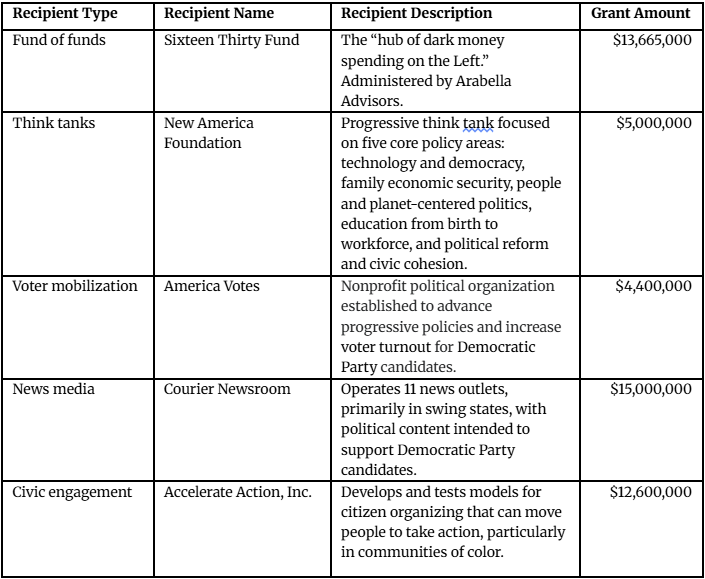
Near the end of his book, Palumbo examines Alex’s first year as OSF chairman (in 2023) by reviewing OSF’s largest grants. Because of the high volume of grants made in 2023, a total of 2,166, Palumbo divides the grants into five main categories: (1) fund of funds (meaning OSF funds groups who fund other groups); (2) think tanks; (3) voter mobilization groups; (4) news media; and (5) civic engagement groups. The table below shows OSF’s largest grants in 2023 for each of the five recipient categories:
In short, Alex is funding the same kind of leftist groups that his father always had.
Palumbo outlines the incredible influence and control that the Soros empire has over the major media. From 2004 to 2011, George spent nearly $50 million funding about 180 American media organizations, and “news infrastructure,” such as journalism schools and media industry organizations. The Media Research Center has found Soros links at over thirty mainstream news outlets.
Palumbo concludes his book with the following comments about Alex Soros:
The new Soros is just like the old Soros, and the only ways they differ are the ways in which Alex is even more radical, and that, unlike his father, he’s openly boasting about his influence. The Soros agenda is still globalism.
Palumbo’s The Heir serves as a warning that well-connected actors with enormous financial resources can buy political influence and steer government funding towards their own ideological objectives and personal enrichment. It highlights the need for greater transparency and accountability in our public institutions.